Noble Eye Care
Gurgaon
Opening Hours
Mon - Fri: 9am -7pm
9811664647
Get in touch
Feel free to ask
What Is Refractive Error in Children?
Refractive error is the need for glasses due to weak eyes. In all forms of refractive error, the eye is unable to focus the image onto the retina and requires corrective lenses in the form of spectacles. The most common form of refractive error is shortsightedness (myopia) which occurs in those eyes which are a little longer than normal and is treated with minus powered glasses. Other forms of refractive error in children could be hypermetropia (farsightedness) where the eye is shorter than normal and requires plus powered glasses, or astigmatism where the shape of the cornea is not spherical/round and requires a cylindrical lens for a clear vision.How Is the Magnitude of Refractive Error Measured?
Nearly 20% of blindness and 75% of visual impairment in the young is caused by refractive error. It is estimated that the prevalence of myopia in New Delhi school children (aged 5-15 years) is over 7%.How Can I Recognise Refractive Error in My Child?
Children with refractive errors may complain of not being able to see the blackboard or may watch TV from a close distance or may read their books from very close. If these signs are there, the child must be examined for the need of glasses. Sometimes, there may be repeated styes in the eyelid or frequent rubbing of eyes by the child. My child is very small and cannot read the eye charts. How will vision be assessed? In children who are too young to read the vision chart, special forms of vision assessment charts are available. These include special cards called Teller acuity cards or Cardiff acuity cards which can assess vision in 6 months to 3 years of age. Children between 3-5 years of age can be evaluated using picture and number charts.How Is Eye Power Checked in Children?
In children, the spectacle number has to be checked after putting some eye drops in the eye to relax the eye muscles. The power must not be given without doing the testing with these eye drops. Since all children have some power in their eyes as they grow up, it is important for the eye doctor to recognize that the power in a child is more than expected and then prescribe appropriate glasses. The power may be checked with either a computerised machine called auto-refractor or manually by doing retinoscopy.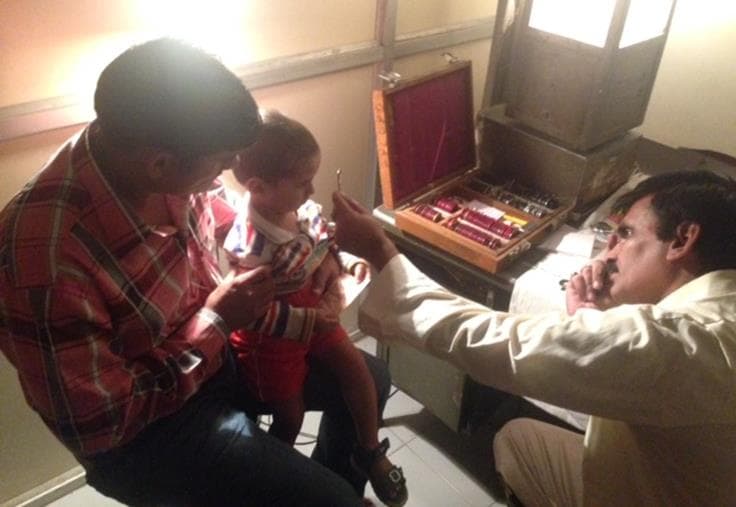 A Child Undergoing Retinoscopy
What Else Is Included in a Child’s Eye Checkup?
An important thing to check in the eyes of children with high minus powers is the retina, as there are sometimes areas of retinal weakness (which may require laser intervention), which are associated in these cases. In children with high plus power or difference in power between the two eyes, squint and lazy eye has to be ruled out.Can Glasses Improve My Child’s Vision?
With a proper refraction and constant use of glasses, good vision is almost always achieved.What Are the Risk Factors for Refractive Error in Children?
There are many factors suspected to be associated with development of refractive errors. These include genetic factors (where parents have glasses), premature and low birth-weight, nutritional factors, spurt in height, environmental factors (near work, indoor activities, higher socioeconomic status) and eye diseases such as eye allergy.Why Are More Children Wearing Glasses Today?
The increased awareness among parents and regular screening in schools is helping pick up refractive errors which were hitherto missed. But there is also an actual increase in prevalence of some forms of refractive error eg. the increase in number of myopic persons in progressive generations can be attributed to increasing near tasks such as working on computer, video games, and television watching.When Should Children Be Screened for Refractive Errors?
It is important to screen all children for refractive errors at the age of 4 when they join school and then on yearly basis.What Happens If a Refractive Error Is Left Uncorrected?
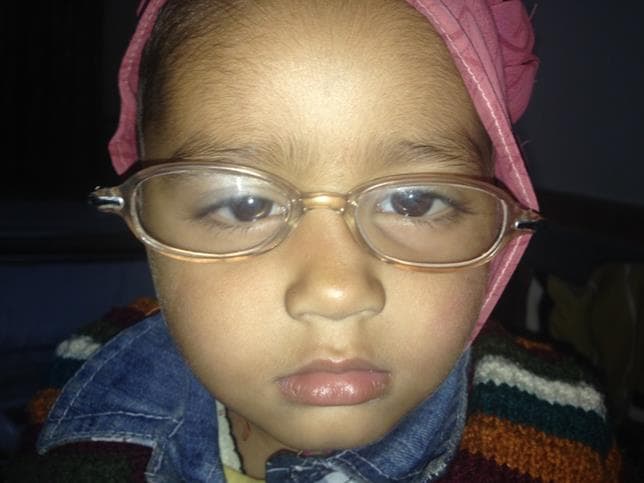
Presence of uncorrected refractive errors can cause the child to fall back in class and have delayed learning and poor concentration in many activities. Uncorrected refractive errors can also cause amblyopia (lazy eye) and squint. A Young Child Wearing Glasses